Creativity Dynamics
Business creativity is 'the thinking of novel and appropriate ideas', not just novel ideas for their own sake. Fundamental challenges facing leaders in the 21st Century are: how to harvest bright ideas when there isn't much time; how to convert bright ideas into innovations that last longer than next week's fad and; how to generate a culture where focused creativity is part of normal business or what we call 'serious play'.
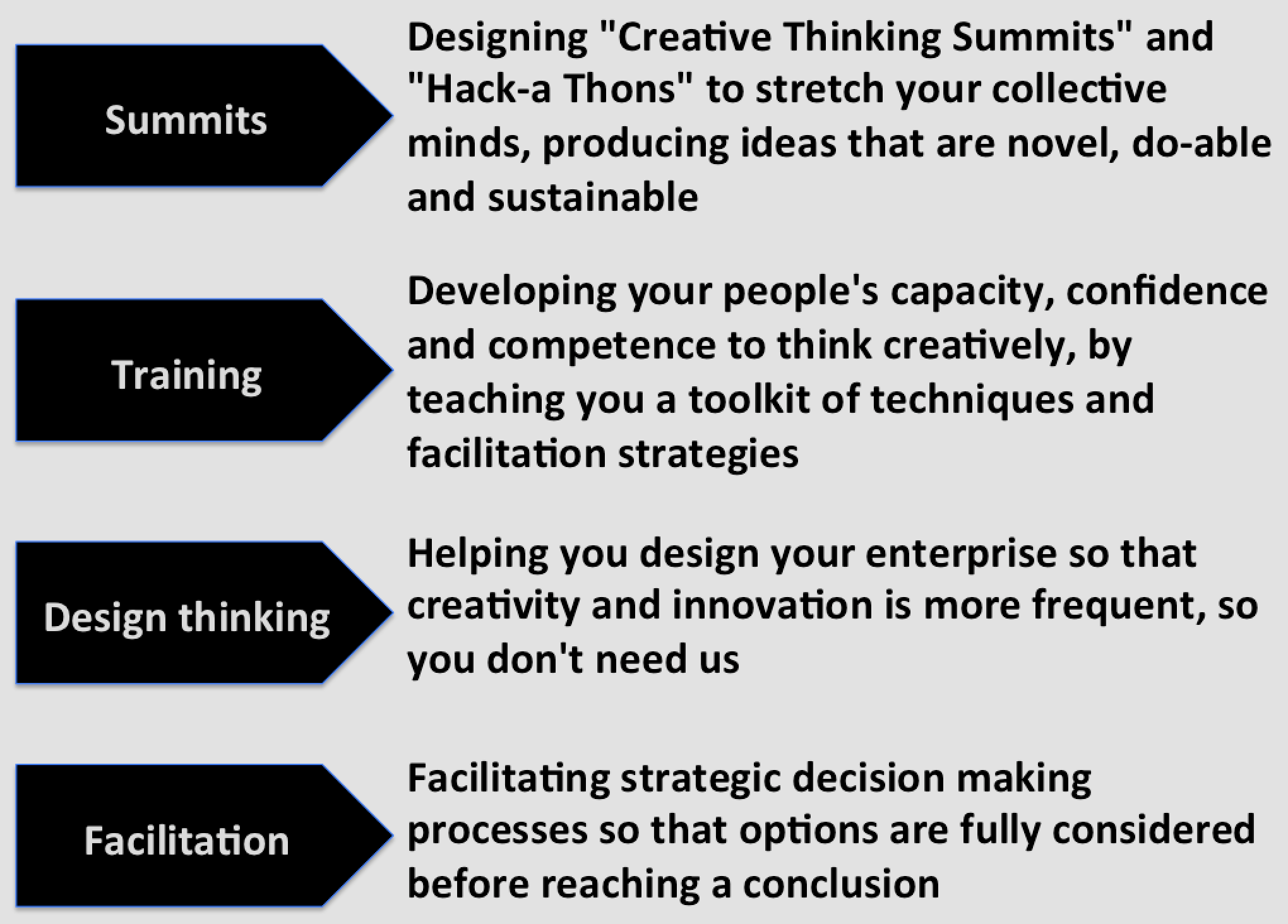
Unlike the branded boutique creativity companies, who offer a neatly packaged but standard product, we use a best-fit approach drawn from a menu of over 120 creative thinking methodologies and techniques, gained from our experience in teaching the subject at MBA level over many years and through real life projects and industry experience. Many people find our approach ultimately to be of greater advantage. Human Dynamics can help by:

Case Study: Practical Creativity
Situation
Our client is a major pharmaceutical company that needs to leverage the full brainpower of its employees to realise its ambitions.
The challenge
To develop the capacity and willpower to use creative thinking for the improvement of process chemistry. This was to enable the company to constantly improve its cost profile and generate 'hard to copy' innovations in process chemistry to keep it ahead in the face of mounting competition.What we did
We designed a bespoke development programme, phased over 18 months, using real-life projects as source materials to maximise the relevance to participants. Broad content included:- The roots of creativity and innovation - identifying personal strategies for creativity and innovation
- Provision of The Creative Thinker's Toolkit - containing a suite of analytical and intuitive approaches to creative thinking for use in 1:1 and group situations
- Developing a culture and climate where creativity and innovation are business as usual characteristics
- Using real life projects that required application of strategies and tools
At the same time we provided organisation development advice, guidance and support to help the unit create a micro-climate where creativity was valued, supported and resourced, so that good ideas would convert into profitable innovations. We supported the unit in the development of an internal brand for creativity as part of the development of a 'unique selling point' for the unit. We also provided 1:1 and small group performance coaching to assist the top team in implementing the changes needed.
Impact
The programme delivered a number of tangible business improvement benefits:- An improved chemical process for an important raw material, with considerable implications for cost savings in the short and long term. This came from the consideration of a 'non-obvious' process step in the chemistry which had previously been discounted.
- Laboratory design improvements which will lead to better cross functional working between different professional groups. Innovations in science these days require considerable cross fertilisation between experts and the results of designing the environment to increase the number of 'happy accidents' is critical in terms of developing breakthrough in new chemical processes.
- An internal champion has taken up the challenge of sustaining creativity throughout the function. They have become a recognised expert on the subject as a result of this and this has produced demands for them to conduct internal consulting assignments within other functions for the company. They now work across the globe delivering assignments.